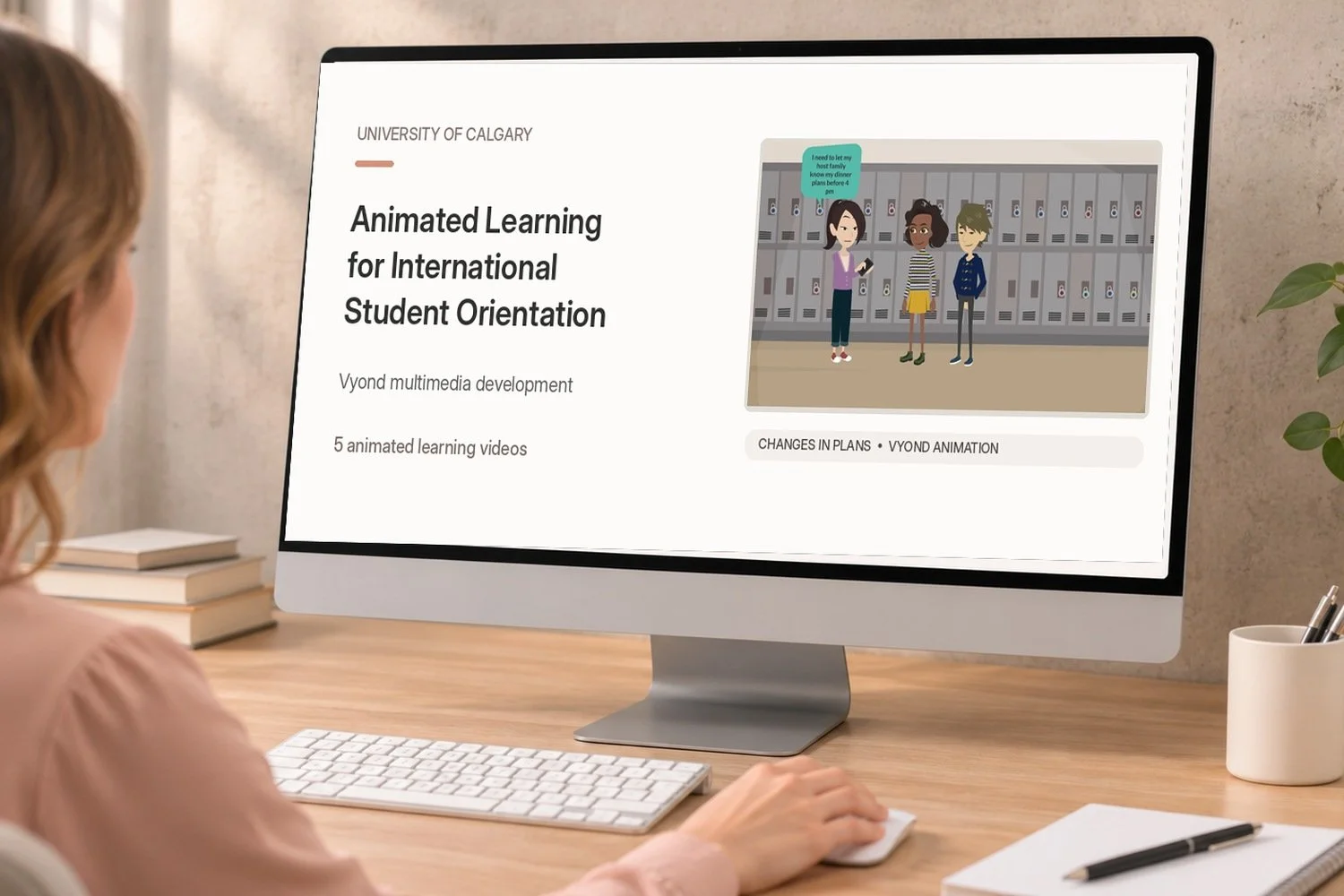
How do you help international students understand everyday expectations that are easier to demonstrate than explain?
For the University of Calgary's English Language Program Homestay orientation, I developed five animated videos in Vyond, transforming provided scripts and storyboards into relatable scenarios that model communication, shared-living expectations, and personal safety.
Project snapshot
Organization: University of Calgary, English Language Program
Audience: International students participating in homestay in Calgary
My role: Multimedia Development and Vyond Animation
Deliverables: Five animated learning videos, approximately eight minutes total
Tool: Vyond
Format: Animated explainers and real-world behavioural scenarios
Selected animated work
Changes in Plans
A short behavioural scenario illustrating timely communication, changes in travel plans, and consideration for household routines.
A Day in Yuki's Life
A day-in-the-life animation demonstrating everyday expectations through connected scenes, including greetings, meal preparation, shared spaces, asking permission, and respecting quiet hours.
Additional animations in the series: Welcome to Homestay, Asking About Leftovers, and Exploring Calgary Safely.
The learning context
Moving into a homestay involves more than understanding house rules. International students must navigate unfamiliar routines, cultural expectations, interpersonal communication, and everyday decisions.
Some expectations are relatively straightforward to explain. Others become clearer when learners can see how people respond in a realistic situation.
The orientation videos illustrated practical moments students might encounter, such as asking permission to use shared food, communicating changes in plans, respecting household routines, and staying safe while exploring Calgary.
The aim was to make these expectations concrete and easier to recognize in everyday life.
My role and production approach
I was responsible for developing the animated video assets in Vyond, working from scripts, narration, and storyboard directions supplied by the project team.
My work involved translating written scene descriptions into visual sequences, building environments, working with animated characters and their actions, and presenting communication and behavioural expectations through on-screen interactions.
Across the five videos, the production required consistency in character representation, visual style, scene transitions, and the relationship between the written narrative and what learners see.
From storyboard to screen
The project team's storyboard outlined three connected moments: communicating plans in advance, handling an unexpected delay, and respecting household routines. I translated these directions into a visual sequence using recurring characters, distinct locations, and on-screen cues to make each behaviour observable.
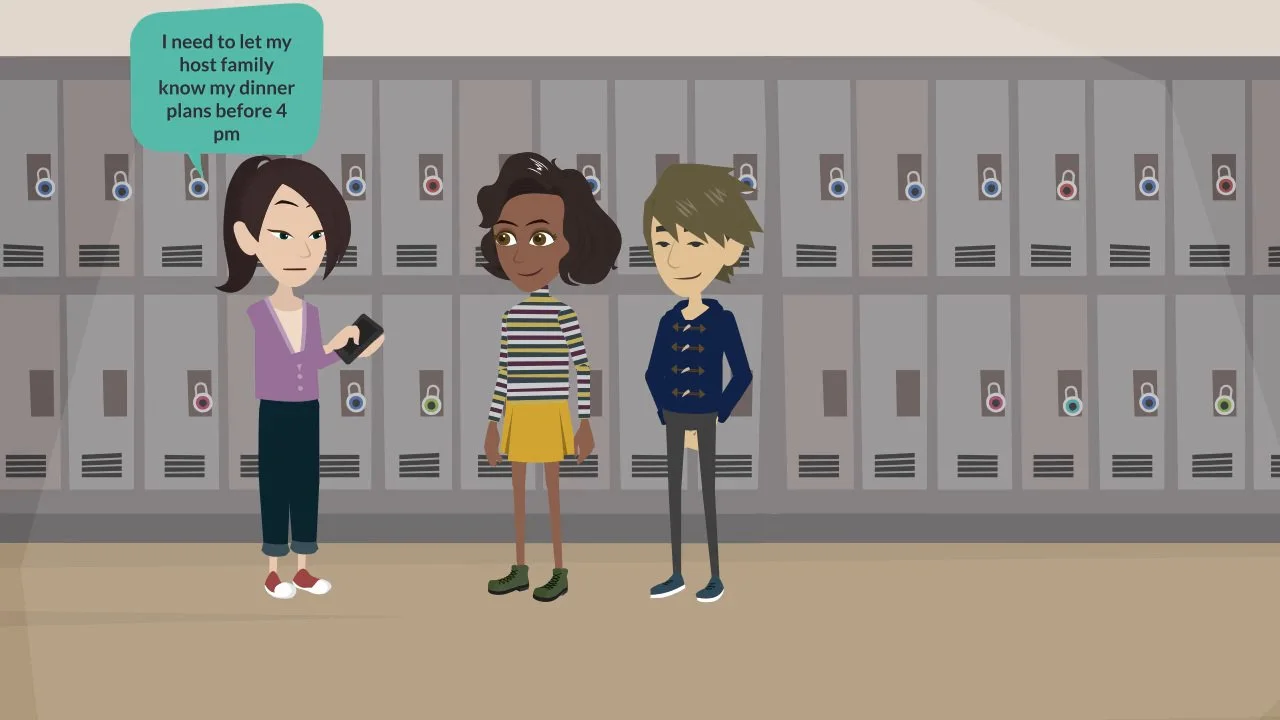
01 | Establish the plan
Storyboard input: Yuki makes dinner plans with friends and remembers to inform her host family before 4 p.m.
Animated execution: A school-hallway scene establishes the social context, while Yuki's on-screen speech bubble makes the communication expectation explicit.
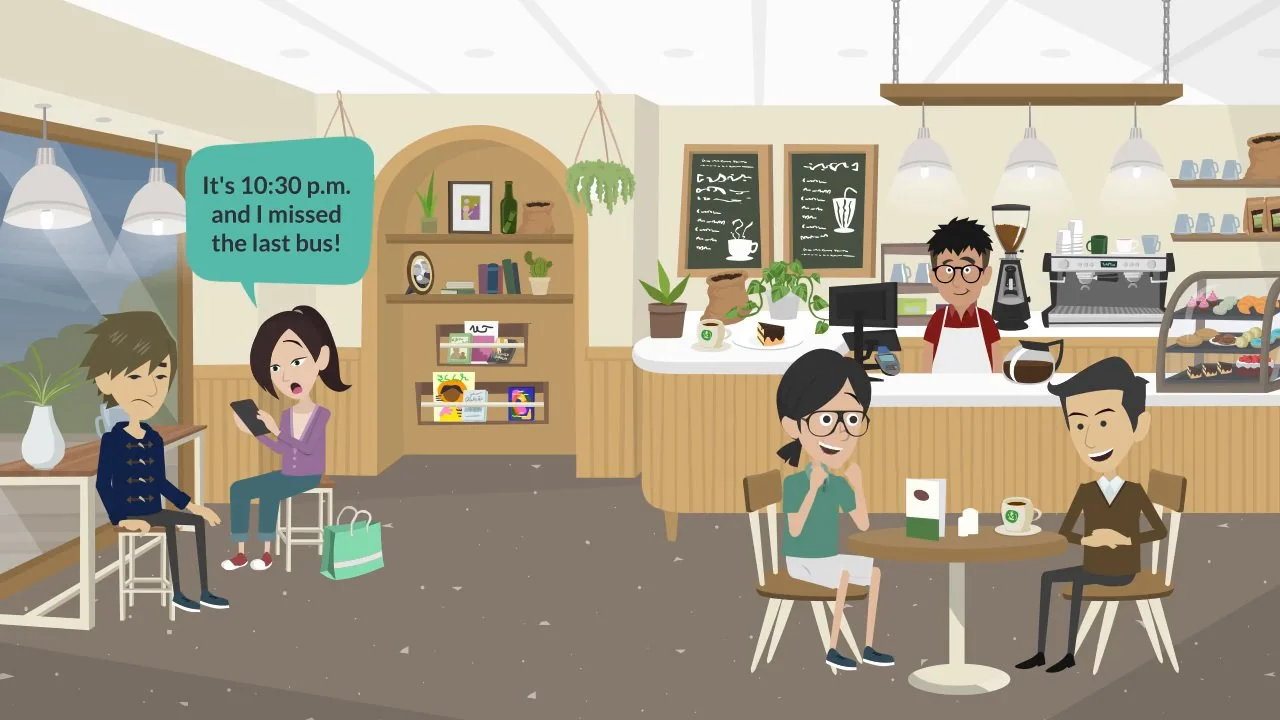
02 | Introduce the complication
Storyboard input: Yuki loses track of time and misses the last bus.
Animated execution: A café scene and Yuki's on-screen realization establish the unexpected problem and create a turning point in the story.
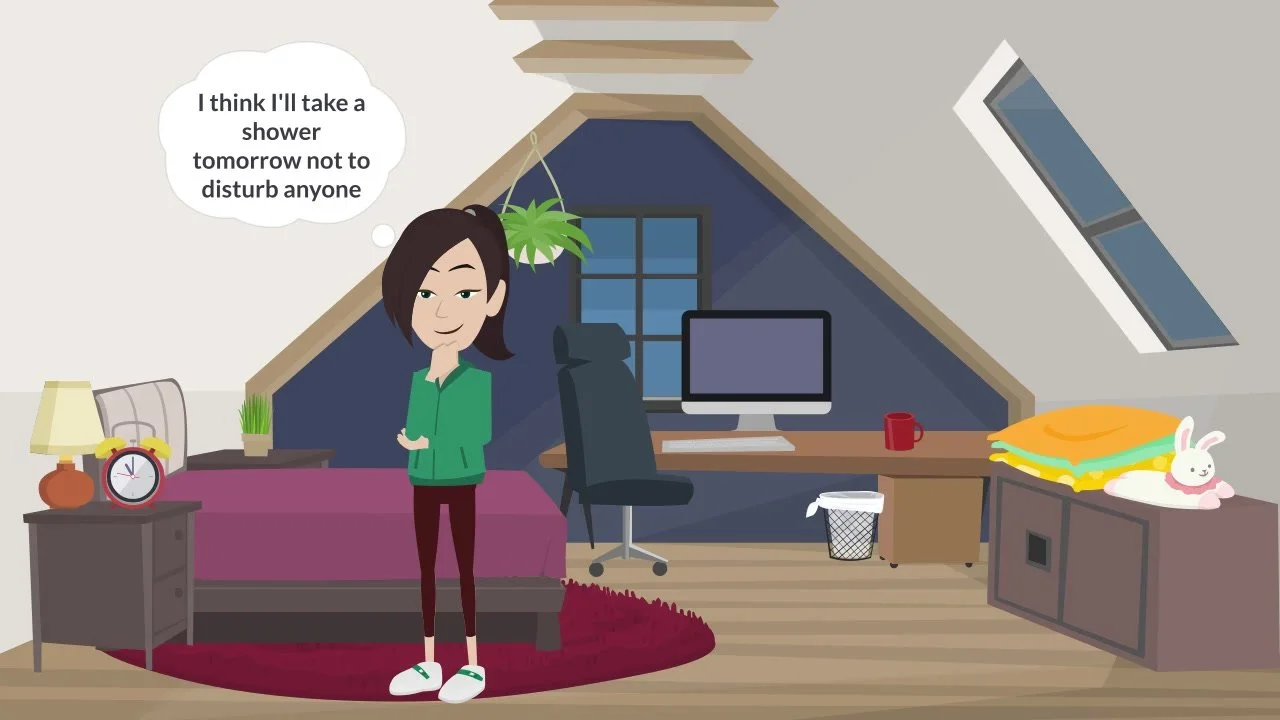
03 | Model a considerate choice
Storyboard input: After returning home during quiet hours, Yuki decides to postpone her shower until the following morning.
Animated execution: A bedroom scene and thought bubble show her reasoning, transforming a household expectation into an observable decision.
Storyboard directions summarized from team-provided production materials. Screenshots from the completed Vyond animation.
Matching Animation to the Learning Message
An animated scenario doesn’t need to be long to be useful. In Asking About Leftovers, a 27-second exchange makes one social expectation visible: ask before taking shared food. A Day in Yuki’s Life uses a longer sequence to show how several household routines connect throughout a typical day.
Developing both videos required attention to scene pacing, character actions, and visual clarity at different levels of complexity.
Reflection
Developing five animations from team-provided storyboards reinforced the importance of translating written instructions into clear visual actions. Character movement, scene transitions, on-screen messages, and pacing all contribute to how a situation is understood. The completed series demonstrates my ability to develop consistent multimedia learning assets from existing instructional materials.
Interested in working together?
Whether you’re hiring a learning designer or developing a new learning experience, I’d love to hear what you’re working on.